Home Health Agencies

Patient communication at every stage of the home health experience.

Linda calls your patients throughout the episode — onboarding, routine check-ins, post-discharge follow-up, satisfaction — persistently and empathetically, and notifies your team the moment someone needs attention. Same staff. More capacity. Nurses back on clinical work.

HIPAA & SOC 2 compliant · BAA before any data moves · Live in as little as 14 days

Why it matters

Your clinical care is excellent. The gap is communication: every stage of the episode depends on calls your team can’t always get to. A patient declining unseen between visits, a missed visit that becomes a LUPA, an unhappy patient discovered by the Medicare survey instead of by you — each is a phone call that didn’t happen.

That same gap leaves revenue on the table. Referrals convert below their potential because no one has time to keep trying. Discharged patients who would welcome further care are never asked. Re-certification opportunities pass quietly. None of it shows up on a report — it’s the revenue you never knew you missed.

And under HHVBP, ±5% of Medicare fee-for-service payments — an $850M national pool — now rides on your quality scores, and the patients you don’t call are the ones that hurt your score most.

The economics

An agency admitting ~1,500 patients a year (~250 daily census, ~$7M Medicare revenue) typically unlocks ~$215K a year in found revenue — reactivated discharges, recovered referrals, and HHVBP capture — with upside approaching $580K.

Call workflows

Each program spells out the objective, who’s called and when, exactly what Linda covers, the triggers that raise an alert, and what your team gets back.

01

Post-Discharge Monitoring & Further-Care Lead Detection

Check in on discharged patients on a set cadence, catch early signs of decline before they become readmissions, and surface warm leads for further care — Private Duty, re-certification, additional services.

Who / when: All discharges (or high-risk cohorts), on a configurable cadence starting 24–72 hours after discharge.

What Linda covers on the call

  • How the patient is feeling since discharge; overall recovery trajectory
  • Medication on hand and taken as directed; any confusion flagged
  • Condition-specific symptom screening (e.g., HF weight gain, breathing changes, wound status)
  • Follow-up appointments in place; transportation barriers captured
  • Interest in additional services — surfacing further-care and re-certification leads with context

When Linda alerts your team

Any concerning symptom, missed critical medication, or inability to reach a high-risk patient after repeated attempts — and every further-care lead, alerted in real time so your team can act while the interest is warm. Those leads are one of the largest revenue opportunities Linda surfaces.

What your team receives

Real-time SMS/email alerts for at-risk patients and warm further-care leads, with the full call report behind every alert.

02

Post-Visit Satisfaction & QA (HHVBP)

A program built for HHVBP — protecting more than HHCAHPS. Catch unhappy patients before the Medicare survey does, and catch emerging medical issues before they become the readmissions that hit your quality score. Both levers of your ±5% payment adjustment, addressed in one call program.

Who / when: Patients after completed visits or episodes, on a sampling or full-census basis.

What Linda covers on the call

  • Short, structured satisfaction questions mirroring HHCAHPS domains
  • Open-ended capture of complaints or praise, summarized for QA
  • Identification of service-recovery opportunities while they’re still fixable
  • A brief well-being check that surfaces medical issues and early rehospitalization risk

When Linda alerts your team

A medical issue or sign of potential rehospitalization; any complaint suggesting a care-quality or safety issue; a patient signaling they’d rate the agency poorly.

What your team receives

A QA dashboard of satisfaction trends, flagged service-recovery cases, and early rehospitalization-risk catches — value across your HHVBP measures, not just HHCAHPS.

03

Referral Follow-Up & Intake Support

Your team makes the all-important first touch with every new referral. Linda takes it from there — persistent follow-up calls and texts to the referrals your team couldn’t reach, so no referral quietly slides to tomorrow.

Who / when: Referrals unreached after your team’s first attempt; persistent retries across the day, paired with SMS.

What Linda covers on the call

  • Re-attempt contact persistently, at times patients actually answer
  • Verify demographics, address, and insurance information for intake
  • Capture availability and scheduling preferences for the start-of-care visit
  • Answer common questions from an agency-approved script; capture ones that need a team member
  • Log opt-outs and wrong numbers so staff never dial dead ends

When Linda alerts your team

Patient or family has clinical questions, expresses hesitation about services, or requests a callback from a specific staff member.

What your team receives

A real-time disposition for every referral — ready-to-book, needs a personal touch, unreachable (with retry history), opted out — with notifications that let intake prioritize instead of dialing.

04

Pre-Visit Clinical Prep & Missed-Visit Prevention

Confirm upcoming visits before dispatch, capture what the clinician needs to know before walking in, and protect episodic billing from LUPAs caused by missed visits. Requires scheduling integration (API) so Linda knows when visits are booked.

Who / when: Patients with visits scheduled in the next 24–48 hours, synced automatically from your scheduling system.

What Linda covers on the call

  • Confirm the visit date, time, and that someone will be home
  • Capture changes in condition since the last visit for the clinician’s pre-brief
  • Reschedule proactively on the call when a conflict surfaces
  • Remind about any prep the visit requires

When Linda alerts your team

Reported deterioration, repeated cancellations on a clinically urgent case, or a patient who cannot be reached before dispatch.

What your team receives

Fewer wasted trips, fewer LUPA-triggering missed visits, and clinicians who walk in already briefed.

What your team gets

Linda does the dialing; your people get the signal. Every program feeds the same four outputs.

Reports and alerts from every interaction

Every call becomes a clear report, and alerts flag the interactions that need staff follow-up — delivered instantly by SMS and email.

A complete profile for every patient or member

Their data (via CSV or API), full history of activity with Linda, every alert and report — plus a place for your staff to add notes.

A real-time dashboard with high-level KPIs

See Linda’s activity across your entire patient or member pool at a glance, and track the numbers that matter.

Full visibility into every program

View your active call programs, the questions each one covers, and the sequence strategy — number of attempts, time between calls, and calling approach.
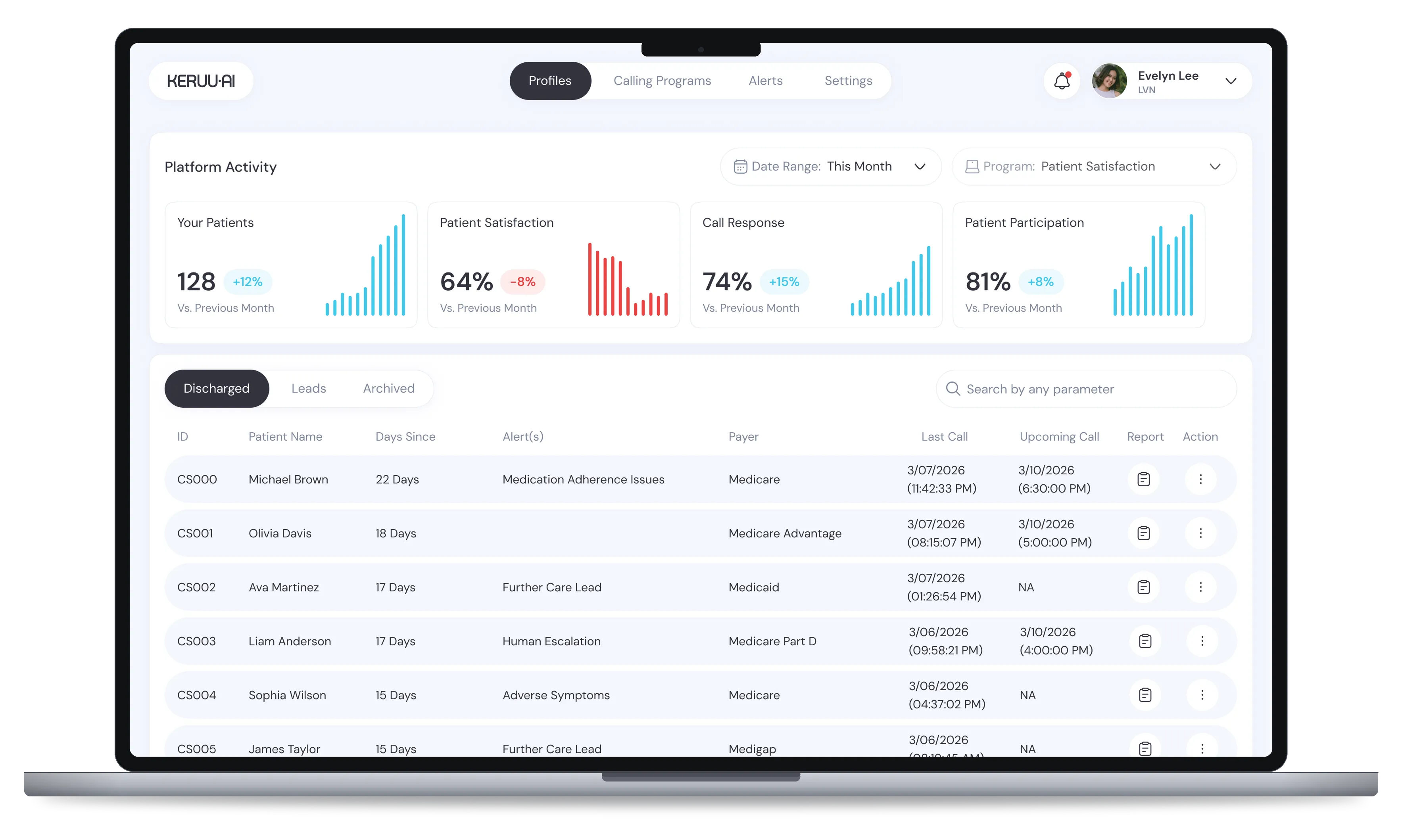
The Keruu dashboard on a MacBook — real-time calls, alerts, reports, and program controls

The escalation promise

Linda is designed to catch what matters, not to replace clinical judgment. When a call surfaces a critical insight — a concerning symptom, a safety risk, a medication question, signs of crisis — your staff get an instant SMS and email alert so they can handle next steps, with the full call report available for context. On these calls, the alert is the success.

Every call program is reviewed and approved by your clinical and compliance teams before launch, and tailored to your protocols and populations.

Want to prove it on your own patients? Our 30-day test-to-buy pilot runs free, with the $5,000 implementation fee waived, no EMR integration, and a BAA signed up front.

Explore the 30-day pilot →

See what Linda can do for your organization.